How long does it take to learn guitar?
Learning guitar takes 1 to 3 months for simple songs, about a year for barre chords, and roughly 5 years of regular practice for an advanced level.
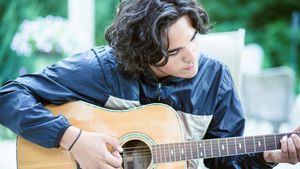
Learning guitar to play simple songs takes most beginners 1 to 3 months of regular practice. Barre chords take about a year, and reaching an advanced level takes about 5 years.
These estimates come from guitar instructors and music schools. Giancarlo Facoetti, who has taught guitar since 2000, finds that beginners play their first songs after 1 to 3 months of practicing three 30-minute sessions a week. Music learning platform Yousician estimates 1 to 3 years to play barre chords and simple solos, and 5 years or more to reach an advanced stage.
Timelines vary widely because learning guitar can mean anything from strumming basic three-chord pop songs to improvising solos across the fretboard.
How many hours does it take to learn guitar?
About 100 hours to play simple songs, and about 1,450 hours to reach an advanced level. These estimates come from Trinity College London, a UK music exam board, and count lessons and practice together.
| Milestone | Hours | What you can play |
|---|---|---|
| Open chords | 100 | Simple songs with open chords (A, D, Em, G) |
| Barre chords | 310 | Movable chord shapes across the fretboard |
| Intermediate | 640 | Scales, riffs, and simple solos |
| Advanced | 1,450 | Complex solos, improvisation, and fingerstyle |
Open chords are the first chords most people learn, such as A, D, E minor and G. They sit near the top of the neck and use some open strings. In a barre chord, your first finger lies flat across the strings. That lets you move one chord shape up and down the neck to play many chords.
If you only want to strum along to simple songs using chord charts, you can get there sooner. Facoetti's students typically play their first open-chord songs after 1 to 3 months of three 30-minute sessions a week (roughly 10 to 20 practice hours). Trinity's 100-hour milestone (Grade 1) covers a broader curriculum, including reading music notation, scales and technical exercises.
How long does it take to get good at guitar?
About 2 years at 1 hour a day, if "good" means you can play barre chords, simple solos and riffs smoothly. Yousician puts this intermediate stage at 1 to 3 years. Trinity's syllabus sets its intermediate benchmark (Grade 5) at roughly 640 total hours, which works out to about 21 months at 1 hour a day (640 hours ÷ 1 hour a day = 640 days).
How long should you practice guitar a day?
About 30 minutes a day to start. Short daily sessions work far better than one long session on the weekend. Daily practice gives your fingertips time to build calluses without blistering, and sleep between sessions helps your hands lock in new chord shapes. As guitar instructor Grey at Hub Guitar puts it: "a few drops every day, not a whole glass all at once."
A guitar practice routine for beginners splits those 20 to 30 minutes into tuning, a chromatic finger warm-up, one-minute chord changes, and playing real songs. Once your fingertips toughen and you can stay focused without hand fatigue, you can extend your sessions to 45 or 60 minutes.
How do you track your guitar practice?
To track your guitar practice and build calluses consistently, log your daily sessions in timespent. In the first few months, practicing consistently matters just as much as total time, since skipping four or five days in a row allows fresh calluses to soften and muscle memory to fade.
You can create a Timed Activity called "Guitar" with a daily goal of 30 minutes, and add it to a Habit Arc to build a daily streak (or an Unscripted Arc to organize your sessions without streaks). timespent adds up your practice hours automatically, so you can see exactly when you pass 100 hours for open chords or 310 hours for barre chords.
Common questions
How long will it take at 30 minutes to 2 hours a day?
Divide the total hours by your daily practice time. At 30 minutes a day, 100 hours takes about 200 days, or 7 months (100 hours ÷ 0.5 hours a day = 200 days).
| What you can play | Hours | 30 minutes a day | 1 hour a day | 2 hours a day |
|---|---|---|---|---|
| Simple songs with open chords | 100 | 7 months | 3 months | 7 weeks |
| Barre chords | 310 | 20 months | 10 months | 5 months |
| Intermediate level | 640 | 3.5 years | 21 months | 10 months |
| Advanced level | 1,450 | 8 years | 4 years | 2 years |
Can you learn guitar in 3 months?
Yes, enough to strum simple songs with open chords. Facoetti finds that most beginners reach their first basic songs in 1 to 3 months. Practicing 1 hour a day for 3 months adds up to about 90 hours (1 hour a day × 90 days = 90 hours), which puts you right near Trinity's 100-hour mark for basic repertoire.
How long do your fingers hurt when learning guitar?
About 3 to 6 weeks for most beginners. According to Hub Guitar, calluses start forming within a few days, and soreness drops off significantly within 3 to 6 weeks of regular playing. If you feel sharp pain, tingling or numbness, that indicates nerve compression rather than normal skin tenderness, so stop immediately and rest your fretting hand.
How long does it take to learn barre chords?
About 10 months at 1 hour a day, or roughly 310 total hours of lessons and practice. At 30 minutes a day, expect it to take about 20 months (310 hours ÷ 0.5 hours a day = 620 days). Barre chords take longer than open chords because your index finger must clamp down firmly across all six strings while your other fingers form chords, requiring both hand strength and wrist stamina.
How long does it take to master guitar?
At least 10 years of consistent playing. Both Facoetti and Yousician place mastery at the 10-year mark, when technical mechanics become second nature and you develop your own distinct musical style. Reaching Grade 8 on Trinity's exam scale takes roughly 1,450 hours of structured study, and professional mastery goes well beyond that.
Does bass guitar take as long as guitar?
Yes, according to music exam guidelines. Trinity sets identical qualification hours across guitar, bass and drums: about 100 hours of combined lessons and practice to play simple songs (Grade 1) and roughly 1,450 hours for an advanced level (Grade 8). While bass lines often involve single notes rather than full chords, mastering rhythm, hand strength and fretboard precision takes the same commitment. By comparison, learning the four-string ukulele is much faster in the first month (60 hours for Grade 1) because its basic open chords use only one or two fingers on low-tension nylon strings.